
What is a Humanitarian to Do when the System is Co-opted?
Amazon Chief Technology Officer Werner Vogels stared through the audience wearing the blank look of a man hiding shame. A small group of activists took over the stage shouting “drop Project Nimbus!” the name of an Amazon and Google collaboration which powers Israel’s targeting and surveillance of Palestinians in Gaza. The protest at this year’s at the AI for Good Global Summit, billed as a place for “unlocking AI’s potential to serve humanity,” exposed a contradiction in the UN-led humanitarian system. American companies that have been household names for decades——Microsoft, Amazon, Google, and IBM——are profiteering from the Israel-US genocide along with military contractor Palantir Technologies. The small number of mostly American billionaire-controlled companies abetting a genocide is for bad, not for good. UN agencies and international NGOs which control the bulk of global humanitarian assistance are at risk of being a vector for Big Tech’s dark ambitions.

Geneva, Switzerland July, 2026
Over the past two decades, Big Tech billionaires, doubling as philanthropists, amassed nation-state level influence with no requisite social contract. Global development was imbued with a palatable logic: Private sector companies donated in-kind services, lobbied governments for contracts, and received access to new markets; government aid funding sustained jobs and industries in donor countries, and generated goodwill abroad; millions received lifesaving interventions. But in focusing on the “win-win-wins,” policy experts have avoided scrutinizing the goals and practices of those concentrating global resources away from democratic control.
By 2018, the tech industry faced what the Financial Times coined “techlash” over growing data privacy and other concerns. Staff at Google, Microsoft, and Amazon organized against their employers’ Pentagon contracts and role in environmental destruction. Tech companies responded by investing in image control. The lesser-known Palantir offered its services for search and rescue missions alongside its growing portfolio with policing and security agencies. By President Trump’s first term, Palantir was already contracted by the Department of Homeland Security’s Immigration and Customs Enforcement (ICE) to build its case management system.
The tech industry’s circular investments are underpinning US GDP growth as AI companies steal intellectual property, fuel exploitation and burn resources at an alarming rate. AI’s insatiable resource demands portend a new normal in rolling blackouts and high energy costs. Tech companies are ripping the spines from remaining physical copies of the rarest antique books. Chatbot usage is linked with instances of mental psychosis, suicides, and cognitive atrophy including in children. It is no wonder that public opinion of the tech industry is at its nadir and unsurprising that it would turn toward the humanitarian sector to rehabilitate its image. But why do humanitarians welcome it?
The World Humanitarian Summit and its Grand Bargain between aid agencies and donor governments are widely considered to be the locus of humanitarian reform during the mid 2010s. But multistakeholder gatherings where companies can showcase products and deepen connections with public sector entities have proven more durable. The “Humanitarian Community of the World Economic Forum (WEF)” launched in 2015 to boost public-private partnerships in humanitarian response. In 2017, IBM and the UN’s International Telecommunications Union launched the AI for Good Global Summit. IBM promised audiences at the WEF that its “Watson” technology would soon deliver “endless” possibilities for social good, such as “help[ing] … humanitarians in war zones to probe, get meaning, and look for connections in dispersed data sets….” Watson didn’t deliver, and IBM notched a serious financial loss, but the model of corporate influence continued. Big Aid lacked resources to keep up with rising humanitarian needs and its ossified bureaucracy was ripe for Big Tech innovation; humanitarian leaders, donor governments, and private sector companies agreed.
When Palantir Locked-in the World Food Programme.
The World Food Programme (WFP) entered into its controversial partnership with Palantir, then a fellow member of the WEF’s Humanitarian Community, through a pilot program in 2017. The same year, Palantir CEO Alex Karp vigorously defended Palantir’s growing role in the detention of unaccompanied children and deportation of families from the United States. WFP Chief David Beasley, who felt strongly that “the last area of privatization is in the area of digitization,” gave the partnership impetus apparently ushering in years of internal uneasiness with little public scrutiny.
A 2012 evaluation of WFP’s Private Sector Partnership and Fundraising Strategy found instances of failure to apply WFP due diligence criteria, and cautioned that “Companies donating purely services in-kind may not currently be subject to due diligence or sign Memoranda of Understanding. This could provide a back-door entry into partnership.” WFP clarified potential risks of misalignment in private sector partnerships in its revised 2013-2017 strategy as submitted to the Executive Board:
WFP may choose not to engage with, or may terminate an existing engagement with, private entities whose public image is compromised by past activity … or whose operations or public statements might otherwise undermine WFP’s reputation.
It further clarified that the same held for private entities that “could be seen to compromise WFP’s neutrality.” WFP extended its in-kind contract with Palantir in 2019, the same year investors expressed alarm over its role in ICE raids and domestic surveillance. Ironically, the investors cited Palantir’s disregard for the UN’s Guiding Principles on Business and Human Rights as a major concern. Findings of Palantir’s human rights violations in connection with ICE were widely published around the time Palantir went public in 2020.
Palantir operates a business model that is widely understood to lock in clients through dependencies on proprietary software, product support from dedicated forward deployed engineers, and contract terms which make it costly and difficult for companies to end their relationship with Palantir, even when circumstances change. The World Food Programme renewed its contract with Palantir most recently this July for a five-year term, despite findings from a leaked 2025 audit which found “high priority” privacy concerns. It has defended the renewal by arguing that its Digital Operations and Transformation System (DOTS) has saved the organization $50 million without specifying the timeline. The amount is far less than the $100 million per year in savings that WFP’s former Chief Information Officer Enrica Porcari claimed in 2019 to anticipate moving forward.
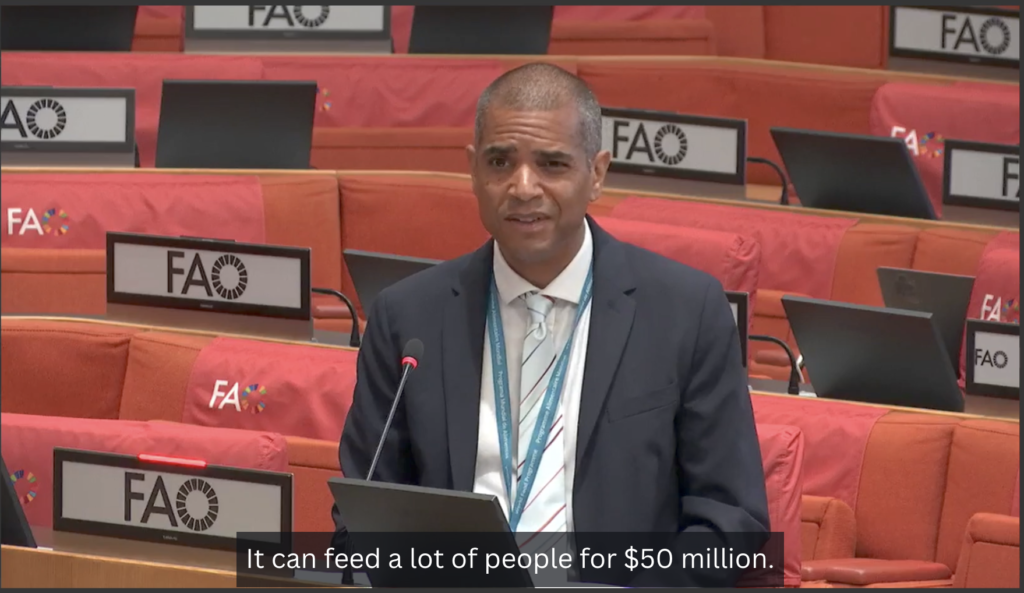
Strapped for resources and pressured to “adapt or die” as the Trump administration has put it, UN agencies and international NGOs are incentivized to accept the support that is on offer from US tech companies. Palantir may not have been present at this year’s AI for Good global summit, but WFP´s Enrica Porcari, involved at the beginning of Palantir’s WFP partnership, spoke at a closed session on “Operationalizing AI across the United Nations system.” UN80 reforms are integrating data with the potential to introduce new dependencies, and risks including tech company preferences, across the UN.
Emerging UN guidance aligns with tech sector priorities by framing AI as an inevitability for which it shares a responsibility to make accessible. Alongside generic calls for regulation, UNICEF has argued that children should be involved in testing AI systems to ensure models are “child centric.” This is during a period of growing debate over the efficacy of ed tech in the classroom including evidence of its negative effects, and awareness that Big Tech platforms target children with addictive features. Citing a need for humanitarian actors to work with Big Tech, UNICEF’s Chief of AI summarized an AI for Good session by calling on humanitarians to
move slightly beyond only thinking and shouting about [accountability] and outrage, and we really need to think about, how do we appeal in a manner that is more appeasing to [tech companies] in terms of how do we think about the rules that must be in place? How do we think about working together collectively…?
While humanitarians mull appeasement, Big Tech aggressively lobby US and European governments to weaken data protections, and shape election outcomes to keep regulation at bay. With humanitarians driving their own AI adoption at this year’s summit, tech companies including Microsoft and Amazon, along with Rwandan President Paul Kagame and others, launched an AI for Good Commission for the purpose of expanding market access and building public trust of AI. Rwanda backs the M23 militia which controls access to coltan operations in Eastern Congo, a central node in the supply of human slavery-driven mineral production. M23 and other groups mete out human rights abuses and smuggle coltan into Rwanda and global supply chains. In 2025 a Trump administration-mediated peace process between Rwanda and DRC secured mining access for a company backed by Jeff Bezos and Bill Gates but left M23’s brutal control intact.
Amid these contradictions, three of the largest US-based international NGOs that partner with UN agencies are embracing AI at scale. In a jointly written op-ed, CEOs of Save the Children US, CARE, and Prosper Global (formerly Mercy Corps) shared their ambition to “change the future of aid” by:
systematically asking communities about their priorities — not just our performance — and using AI tools to analyze those insights at scale, helping shape programs, and equipping communities with data they can use to advocate for change. This will replace more extractive, donor-driven data collection with a community-led dialogue that amplifies their voices to both global and local groups.
Introducing AI at scale would not seem to guarantee a less extractive data collection process than what exists now. Neither would it have any automatic bearing on data access or utility for local communities, nor on the amplification of their voices in venues where big decisions (like the one to deploy AI “at scale”) are made.
The peak of AI mania at this year’s AI for Good summit was a session featuring American computer scientist and long-reigning tech optimist Ray Kurzweil. The moment revealed something important about the ideologies of the Big Tech billionaire cohort. As Kurzweil’s AI avatar remarked in uncanny, corny AI slop:
Technology is not something happening to us, but something evolving from within us to expand our humanity. We are not going to be replaced by our creations. We are going to merge with them, overcoming our oldest limitations, conquer disease, multiply our creativity millions-fold. The future is an exponential journey of hope, and we are writing its code together right now.
Kurzweil’s singularitarian future does not include “humanity” as we know it. Neither does Palantir cofounder Peter Thiel’s vision of “transhumanism, where your human natural body gets transformed into an immortal body,” as he recently described his own belief in the future of AI. This quasi-religious, future-orientation is useful for avoiding scrutiny of AI today. When the moderator asked Kurzweil for his views on responsibility with respect to the development of AI weapons systems, Kurzweil equivocated both times.
But many do experience technology as something that is “happening to us.” Data centers are roiling communities with little public recourse. There is no end in sight to the high-tech Israel-US genocide in Gaza. The same companies profiting from slaughter and surveillance aid in the suppression of public dissent in the United States and other traditional humanitarian donor countries. They also process and store vast amounts of critical humanitarian data. Emergency Relief Coordinator Tom Fletcher shared his own concerns at a recent Chatham House event:
Data is now, as everywhere, a battleground in our sector. I don’t know who will emerge to control humanitarian data, and I worry a lot about the implications of all that. I could probably do much more with the tech companies if I trusted them more, and ten years ago when I launched “The Naked Diplomat” here, I was going, “Oh,” you know, “Facebook, Google, this is, you know, the future,” you know, “Twitter.” I’m a little bit more chastened now about the likelihood of tech companies being trustworthy with the data of the people we serve.
But the pressures to engage with Big Tech are strong within the UN system as they are within governments. The same day Drop Site News reported on the extent of Microsoft’s complicity as a cloud service provider to Israel’s military, ERC Fletcher himself was at the World Economic Forum in Davos holding “excellent brainstorming meetings” with Microsoft and Google.
When Everything is Political.
The US government is overwhelmed by political lobbies and constrained by an increasingly authoritarian executive branch, making its relationship with the UN especially volatile. ERC Fletcher has acknowledged the awkward fact that the United States government remains the largest source of funding entering the UN system. His joint press briefings with Acting Under Secretary of State Jeremy Lewin have hewed away from questions regarding Lewin’s role in what are projected to be hundreds of thousands of deaths resulting from the USAID shutdown. Lewin was instrumental in shuttering USAID as an agent of Elon Musk’s DOGE team.
Authoritarianism scholar Ruth Ben-Ghiat has described Musk’s dismantling of the administrative state as evidence of a power-sharing agreement with President Trump as a reward for political donations. DOGE fulfilled President Biden’s too-late-to-heed warning of a “tech industrial complex,” which is evident in administrative and policy changes. President Trump produced a national security presidential memorandum (NSPM-7) paving the way to target people engaged in First Amendment protected activities. The administration is now contracting Microsoft, Amazon, Google, OpenAI and others to process commercially available data for use in mass surveillance. While Musk is no longer attending Cabinet meetings, he is throwing his lot into the midterms.
At the Pentagon, the Army has unprecedentedly begun commissioning Big Tech senior executives who have no military experience as lieutenant colonels in a dedicated unit. So far at least seven executives from Palantir, Meta, OpenAI, and other tech companies have joined the unit and refused to recuse themselves from contract dealings with the US government of which they are involved. The Pentagon also seeks to spend up to $244 million on Palantir services over the next two years, related to a new program which embeds private sector business leaders from the US’ defense industrial base directly into the acquisition process.
The US Congress is leading an effort to fuse the US and Israeli military industrial bases through the annual National Defense Authorization Act (NDAA). The Pentagon’s Defense Intelligence Agency has assigned the Government of Israel the highest threat level to the United States due to espionage risks. The NDAA provision has passed in the House and is poised to lock in the privileged sharing of sensitive research and technologies. Its implementation would complicate future congressional oversight of the relationship between the US and Israel.
Palantir has co-located with the legally contested Board of Peace in southern Israel. It continues to support Israel’s military, has recruited from its military intelligence unit 8200, and has tracked aid in Gaza through a scheme that undermines the UN system. The World Food Programme is now being forced to cut assistance across the Occupied Palestinian Territories. Under these conditions, efficiency gains from working with Palantir are unlikely to accrue to Palestinians, but it is feasible that exchanges of knowledge and resources between WFP and Palantir could benefit the occupation and genocide in Gaza.
The World Food Programme will remain under US leadership as it has since 1992. Luke Lindberg, US Under Secretary of Trade and Foreign Agricultural Affairs, and son-in-law of Senate Majority Leader John Thune, has been selected as the next WFP chief. The decision was revealed shortly after the US government announced $800 million in funding to WFP and paid a portion of its owed assessed UN contributions. Lindberg joined the USDA in the months after DOGE made headlines for accessing USDA data where he oversaw the transfer of the US government’s remaining food aid programming to USDA, and the signing of a $300 million no bid contract with Palantir. While there is an expectation for UN leaders to serve independently of the interests of any country, the long history of US exceptionalism within the UN provides cause for concern with respect to Lindberg’s independence.
The humanitarian system increasingly resembles the post-humanitarian management of surplus populations described by Mark Duffield more than the principled, lifesaving system practitioners tend to observe. UN80 reforms are likely to entrench UN dependencies on the United States and its corporate partners. But the dominant view of private business and public service providers as coequal stakeholders with overlapping interests is also under pressure.
Shifting views on technology and its relationship with authoritarian forms of control compete with the enduring spectacle of normalcy. Trump’s Board of Peace illustrates these dynamics. Ajay Banga, current World Bank President and former Mastercard CEO during the early days of the WEF’s Humanitarian Community, and Sigrid Kaag, onetime Eminent Person of the Grand Bargain, both participate within Trump’s Board of Peace today. They lend an air of professionalism to the corrupt enterprise while its dedicated World Bank account sits empty. This path of trading international legal legitimacy and humanitarian principles for simulacra, is practically guaranteed to scale without intervention.

There are important precedents for resisting and correcting the worst impulses of tech companies led by staff. Campaigns like No Azure for Apartheid and No Tech for Apartheid press leadership for accountability for their partnerships with the US Pentagon and Israeli government. Employee pressure helped force Microsoft to admit that its work with the Israeli Defense Forces unit 8200 failed its own internal due diligence processes in the unit’s usage of Azure for mass surveillance. Google DeepMind workers have recently unionized to prevent its technology from benefiting the US and Israeli militaries. OpenAI staff have formed a competing Political Action Committee to undermine the company’s political spending and lobbying to eliminate guardrails on AI development. A group of Microsoft shareholders and those of other large tech companies are continuing to press for the implementation and explanation of human rights due diligence processes. Recent shareholder proposals to hold Palantir to account have failed to pass but may still effect stock prices.
It’s Time to Organize.
UN and international NGO staff can take similar steps to press for greater accountability within their own organizations. Events over the past several years show that organizing tactics are adaptable and able to achieve results. Staff can assess whether and how to accept a degree of personal or professional risk and think about how to start small. Here are some ideas of what staff can do now:
- Demand investigations and explanations of how UN agencies and international NGOs apply the UN’s Guiding Principles on Business and Human Rights in their own due diligence.
- Provide leaders with evidence of Big Tech’s moral failings and the incompatibility of its actions with humanitarian principles.
- Coordinate internally to prepare questions and build a record of leadership responses which can be followed up and advocated around moving forward.
- Interrogate your organization’s positions for their alignment with private sector priorities versus the demands of affected communities.
- Press leadership to reject opportunities that celebrate companies with poor human rights track records, including Palantir, Microsoft, Amazon, and Google. Even if it is not possible to extirpate from them, it should be possible to deny them praise without accountability.
- View multistakeholder spaces as contested political arenas where actors without public mandates often set the agenda and shape the discourse.
- Explore how social movement tactics can be effectively adapted to humanitarian policy spaces and coordinate with aligned external campaigns.
- Safely share information with journalists and independent researchers.
- Dissect leadership arguments for logical fallacies and corporate talking points.
It might feel wrong to make internal demands on a system which is under stress and still delivering lifesaving assistance to many. But asking questions is a relatively low-risk activity to begin shaping institutional culture and building transparency and accountability. On the other hand taking no action can already be seen to risk the takeover of humanitarian systems by powerful companies invested in a dystopian future.
Is this the future you want to see? where AI executives can pretend like they have the answers and they are doing good? And you’re giving them the stage!
-Protester at the AI for Good global summit